
What the PPDV Certification Taught Me About Building the Right Product
A few months ago, while exploring product management and Agile-related certifications, I noticed something interesting.
Most courses were heavily focused on frameworks, ceremonies, workflows, or delivery processes. Everything revolved around execution.
But very few were talking deeply about something more important:
How do we know we are solving the right problem in the first place?
That question stayed in my mind for quite some time.
And honestly, the more I reflected on my own professional experience across finance operations, data analysis, reconciliation, automation, and process improvement, the more I realized something uncomfortable:
Many teams become extremely efficient at building things nobody actually needs.
That realization is what eventually led me toward the Professional Product Discovery and Validation (PPDV) certification from Scrum.org.
This post is not a promotional review of the certification.
It’s more of a reflection on:
- why I decided to pursue it,
- how I prepared,
- what I learned,
- and why I think this way of thinking matters far beyond software teams.
What Exactly Is the PPDV Certification?
The Professional Product Discovery and Validation (PPDV) certification by Scrum.org focuses on one simple but powerful idea:
Build the right product before building the product right.
At first glance, that may sound obvious.
But in reality, many organizations skip this completely.
Teams often jump directly into:
- feature discussions,
- sprint execution,
- deadlines,
- delivery pressure,
- and implementation plans.
Meanwhile, basic questions remain unanswered:
- Do users actually need this?
- Is this solving a real pain point?
- Are we working on assumptions or evidence?
- Are we creating value or just activity?
That’s where PPDV becomes interesting.
The course focuses heavily on:
- product discovery,
- experimentation,
- validation,
- customer understanding,
- evidence-based decisions,
- and reducing waste before scaling effort.
And honestly, I liked that immediately.
Because this approach connects deeply with the philosophy behind my platform:
Why Before How
Before discussing execution, tools, or solutions, clarity matters.
Why are we doing this?
What problem are we solving?
What outcome actually matters?
PPDV felt less like a certification and more like a structured way of thinking.
Why I Personally Decided to Pursue This Course
My background is not purely technical product management.
Most of my experience comes from areas like:
- finance operations,
- reconciliation processes,
- reporting,
- compliance,
- process analysis,
- automation-related workflows,
- and analytical problem-solving.
And over time, I noticed a repeating pattern.
Sometimes companies automate broken processes.
Sometimes teams measure performance using meaningless metrics.
Sometimes huge effort goes into solving symptoms while the actual root problem remains untouched.
Honestly, I’ve seen situations where people worked incredibly hard on things that probably should not have existed in the first place.
That observation pushed me toward product thinking.
Not “product management” in the LinkedIn buzzword sense.
Real product thinking.
The kind that asks:
- What problem are we solving?
- Who actually benefits from this?
- What evidence supports this decision?
- What happens if our assumption is wrong?
That curiosity is what made PPDV genuinely valuable for me.
Where I Found Details About the Course
I discovered the course directly while exploring learning paths on Scrum.org.
Initially, I was researching certifications related to:
- Scrum,
- Agile,
- product ownership,
- and product thinking.
But many certifications felt too process-oriented.
PPDV stood out because the focus was different.
It wasn’t only about managing work.
It was about understanding value.
That distinction matters more than people realize.
I also spent time reading:
- Scrum.org resources,
- certification pages,
- community discussions,
- and learner experiences.
One thing I appreciated early was that Scrum.org assessments generally test understanding, not memorization.
That made me more interested in the certification.
How I Prepared for the Exam
Honestly, I did not prepare for this exam by trying to memorize answers.
That approach rarely works long-term anyway.
Instead, I focused on understanding concepts properly.
I Tried Connecting Everything to Real Situations
This helped me a lot.
Whenever I learned something related to:
- assumptions,
- experimentation,
- validation,
- or customer problems,
I tried relating it to practical situations I had observed professionally.
For example:
- inefficient workflows,
- reporting gaps,
- unnecessary approvals,
- poor user experiences,
- or systems designed around process convenience instead of actual user needs.
Once concepts become relatable, studying becomes much easier.
I Created My Own Notes
This was probably one of the most useful things I did.
I converted concepts into:
- simple explanations,
- small observations,
- mental models,
- and practical examples.
Writing notes forces clarity.
You quickly realize whether you genuinely understand something or whether you only feel like you understand it.
I Focused More on Thinking Than Terminology
Many certification exams can be cleared through memorization.
This one felt different.
The concepts required interpretation and judgment.
So instead of obsessing over terminology, I spent more time understanding:
- why discovery matters,
- how assumptions create risk,
- and how validation reduces waste.
My Exam Experience
The exam was challenging, but in a good way.
It did not feel like a memory test.
Many questions required situational thinking.
A few questions genuinely made me pause and think carefully:
- What exactly should be validated first here?
- Which assumption is most risky?
- Is the team focused on outputs or outcomes?
- Are they solving the correct problem?
And honestly, I enjoyed that.
Because that’s how real-world decision-making works too.
In actual organizations, problems rarely arrive in neat textbook format.
There’s ambiguity.
Conflicting assumptions.
Incomplete information.
Pressure to move fast.
The assessment reflected that reality quite well.
What I Learned from This Course
This course changed how I think about work more than I expected.
Not just product work.
Work in general.
A few lessons stayed with me strongly.
Activity Does Not Automatically Create Value
This was one of the biggest takeaways for me.
Teams can remain busy for months and still create very little real value.
More meetings.
More dashboards.
More features.
More processes.
None of that guarantees usefulness.
That sounds obvious when written down, but many organizations still confuse motion with progress.
Assumptions Become Dangerous When Nobody Questions Them
This happens everywhere.
Sometimes teams assume:
- users want a feature,
- a process is necessary,
- a metric is meaningful,
- or a workflow is efficient.
But assumptions without validation slowly become organizational blind spots.
PPDV reinforced the importance of evidence-based thinking.
Understanding Users Matters More Than Building Features
People rarely care about features themselves.
They care about:
- convenience,
- clarity,
- speed,
- reduced frustration,
- or solving a specific problem.
That mindset shift sounds small, but it changes how you approach decisions completely.
Practical Things I Learned That Apply in Real Life
This was probably the most valuable part of the course for me.
The learning felt practical, not theoretical.
Validate Before Scaling
Not every idea deserves massive investment immediately.
Sometimes small experiments reveal huge flaws early.
That can save:
- time,
- money,
- effort,
- and unnecessary complexity.
Honestly, this applies far beyond software products.
Solve Root Problems, Not Surface Symptoms
This connected deeply with my own experience.
Organizations sometimes optimize workflows without questioning whether the workflow itself still makes sense.
PPDV repeatedly reinforced the importance of understanding root problems properly.
Outcomes Matter More Than Outputs
This lesson applies almost everywhere.
Completing tasks is not the same as creating impact.
The important question is:
Did the work actually improve something meaningful?
That’s a very different way of thinking.
What Professionals Should Learn from This Course
I genuinely believe this course is useful beyond product managers or Scrum professionals.
People working in:
- operations,
- business analysis,
- finance,
- consulting,
- marketing,
- customer experience,
- or leadership
can benefit from this mindset.
The biggest lesson?
Don’t become emotionally attached to solutions too early.
Slow down first.
Understand the problem deeply.
Question assumptions.
Look for evidence.
Validate before scaling.
That principle alone can prevent enormous waste.
My Certificate and Scrum.org Profile
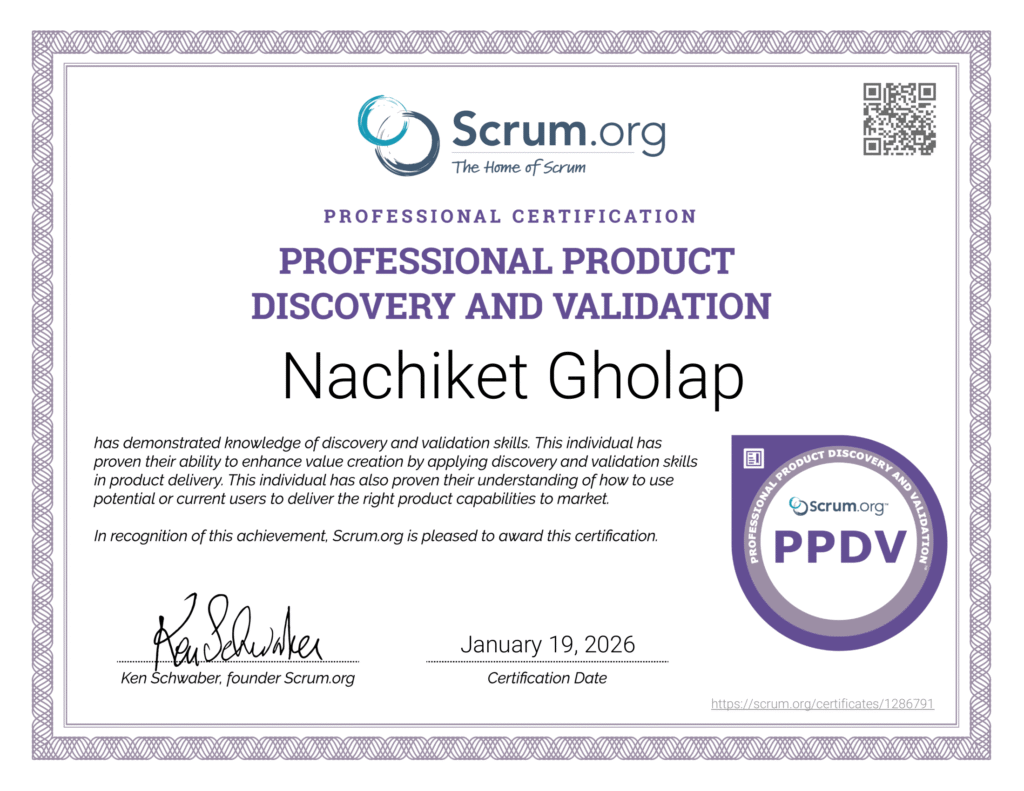
I successfully earned the Professional Product Discovery and Validation (PPDV) certification from Scrum.org on January 19, 2026.
You can view:
- My Scrum.org profile: Nachiket Gholap Scrum.org Profile
- My certificate verification: PPDV Certificate Verification
Final Thoughts
The interesting thing about this certification is that it did not simply teach me product concepts.
It sharpened my thinking.
And honestly, I think that matters more.
In a world where everybody is rushing toward execution, automation, AI tools, and faster delivery, the ability to pause and ask better questions is becoming increasingly valuable.
Sometimes the biggest improvement is not doing things faster.
It’s understanding whether the thing should be done at all.
And that, in many ways, reflects the core philosophy behind Why Before How.
Key Takeaways
- PPDV focuses on discovery and validation before execution
- The course strengthens evidence-based thinking
- Understanding customer problems matters more than feature quantity
- Validation reduces wasted effort and assumptions
- Product thinking applies beyond software teams
- Real value creation requires clarity, not just activity
What are your thoughts on this?
Do modern organizations spend enough time understanding problems before rushing into solutions?